

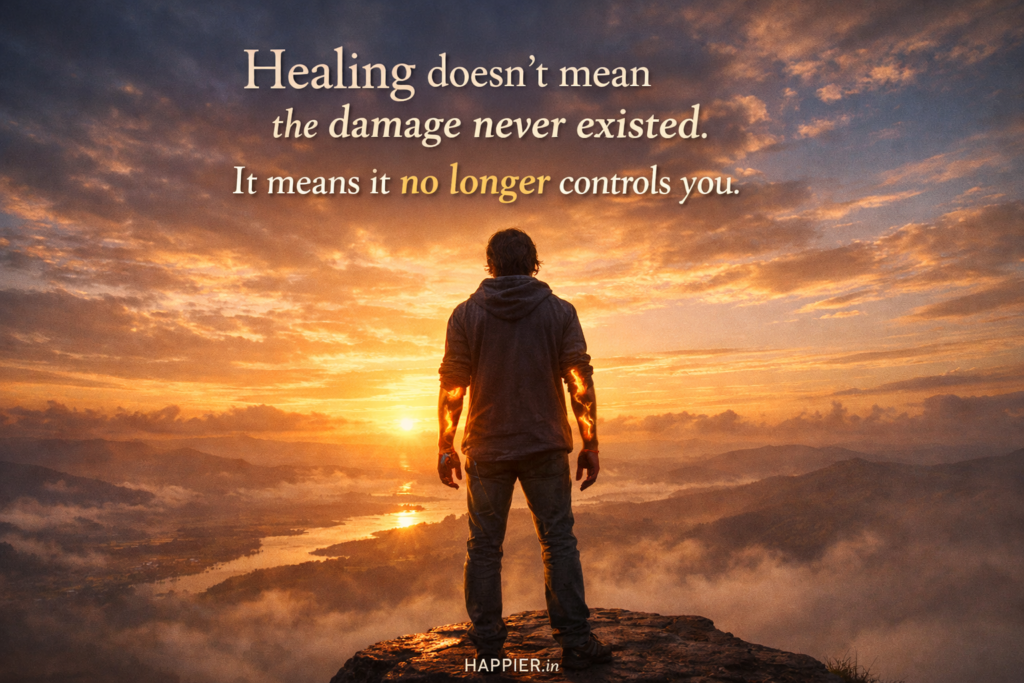
"Healing doesn't mean the damage never existed. It means it no longer controls you."
I was 34 years old when I finally understood what healing actually means.
For years, I believed healing meant going back to who I was before the trauma.
Before the loss. Before the betrayal. Before the diagnosis.
I thought healing meant the wound would disappear completely, like it never happened.
I was wrong.
And that misunderstanding kept me stuck in suffering far longer than the original pain ever did.
The Lie We've Been Sold About Healing
Our culture has given us a dangerous narrative about healing: "Just get over it." "Move on." "Let it go." "Forgive and forget."
These phrases suggest that healing means erasure. That if we're truly healed, we shouldn't be affected anymore. We should be "back to normal."
But here's the truth that changed everything for me: Healing doesn't mean the damage never existed.
It means the damage no longer controls you.
Let me say that again because it's important: The scar can remain. The memory can remain. The sensitivity can remain.
What changes is your relationship to it.
My Body Remembers (And That's Okay)
Three years ago, I was in a car accident. Nothing catastrophic, but significant enough. Physical therapy helped. Medication helped. Time helped.
But my body remembered.
For months afterward, every time I heard screeching tires, my shoulders would tense.
My breath would catch.My hands would grip whatever I was holding. I thought something was wrong with me.
"Why can't I just move past this?" I'd ask myself. "Why is my body still reacting?"
Then I met Dr. Bessel van der Kolk's work on trauma and the body.
He writes, "The body keeps the score."
Your body remembers what your mind tries to forget. That's not a flaw in your design. That's your nervous system doing exactly what it evolved to do—protect you.
The question isn't "How do I make my body forget?"
The question is "How do I help my body understand it's safe now?"
Healing as Transformation, Not Erasure
Think of healing like the Japanese art of kintsugi—repairing broken pottery with gold.
The bowl that breaks isn't thrown away. It isn't pretended to be unbroken. Instead, the cracks are filled with precious metal, making the piece more valuable and more beautiful than it was before.
The break becomes part of the story. The repair becomes part of the beauty.
That's what true healing looks like.
When I finally understood this, everything shifted. I stopped trying to erase my past and started learning to integrate it.
The Three Phases of Deep Healing
Through my own journey and working with thousands through Happier.in, I've observed three distinct phases of healing: Phase 1: The Acute Phase—Survival Mode This is immediately after the trauma, loss, or pain. Your only job here is survival. There is no "healing" in this phase—there is only enduring. And that's exactly as it should be. If you're in this phase right now, hear me: You don't have to be strong. You don't have to be positive. You just have to breathe and make it through today.
Phase 2: The Integration Phase—Making Meaning This is where most people get stuck because they're trying to erase rather than integrate. In this phase, you begin to build a new relationship with what happened. Not forgetting it. Not minimizing it. But slowly, carefully, beginning to hold it without it holding you. This is where therapy helps. Where community helps. Where practices like journaling, somatic movement, and mindful breathing become essential.
Phase 3: The Transformation Phase—Wisdom & Service This is when the scar becomes your strength. When your pain becomes your purpose. When what broke you becomes what makes you wiser, more compassionate, more alive.
You can't rush to Phase 3.
But you also don't have to stay in Phase 1 forever.
Why Your Body Won't "Just Get Over It"
Here's what I wish someone had told me years ago: Your body doesn't operate on logic. It operates on felt safety.
You can tell yourself "I'm safe now" a thousand times, but if your nervous system hasn't received that message, your body will keep reacting.
This is why cognitive approaches alone (just changing your thoughts) often aren't enough for deep healing. You have to work with the body.
Practical Tools for Somatic Healing
These practices helped me move from "my body won't let me heal" to "my body is teaching me how to heal": 1. The Body Scan Practice Lie down. Close your eyes. Slowly scan your body from head to toe, noticing where you hold tension, numbness, or pain. Don't try to fix it. Just notice it. Name it. Thank it for trying to protect you.
2. Pendulation (The Swing Technique) When trauma or pain arises in your body, don't fight it. Instead, notice it, then consciously shift your attention to a part of your body that feels neutral or pleasant. Swing back and forth between the pain and the neutrality. This teaches your nervous system that you can touch the pain and still return to safety.
3. Shaking Release Animals do this instinctively after a threat. Stand and gently shake your body for 2-3 minutes. Let your arms, legs, shoulders shake out. This helps discharge stored stress and trauma from your nervous system.
4. The Healing Breath Place one hand on your heart, one on your belly. Breathe in for 4 counts, hold for 4, exhale for 6. Do this for 3 minutes. The longer exhale signals to your vagus nerve that you're safe.
The Permission You've Been Waiting ForYou have permission to not be over it yet. You have permission to still have triggers. You have permission to have good days and terrible days, sometimes in the same hour.
You have permission to heal at your own pace, in your own way.
Healing isn't linear. It's a spiral. You'll revisit the same wounds at different depths, each time with more wisdom and less suffering.
What Healed Actually Looks Like
After years of this work, here's what healing looks like for me now: The car accident? I still notice a slight tension when I hear screeching tires. But now I notice it with curiosity instead of fear. I can say, "Oh, my body is remembering. That makes sense. I'm safe now." And within seconds, the tension releases.
The tension is still there. But it no longer controls me.
The memory remains. But it no longer defines me.
The Difference Between Healing and Healed
Here's a subtle but crucial distinction: "Healing" is a verb. An ongoing practice. A relationship you tend to.
"Healed" is an adjective. A fixed state. A destination you arrive at.
I don't believe anyone is ever fully "healed" in the sense that they're done, complete, finished.
But we can be "healing" - actively engaged in the sacred work of tending to our wounds, honoring our scars, and choosing freedom over victimhood.
Your Scar is Not Your Shame
In our culture, we're taught to hide our scars. Physically and emotionally.
"Don't burden others with your pain." "Keep it together." "Put on a brave face."
But what if your scar is your superpower?
What if the very thing you think disqualifies you is actually what qualifies you to help others?
The deepest healing I've experienced came from being witnessed by someone who had been where I was. Someone whose scars gave them the wisdom to hold space for mine.
Your wound, when tended to with compassion, becomes your medicine—for yourself and for others.
The Action Plan: Your Next 30 Days
If you're ready to shift from "trying to erase" to "learning to integrate," here's your roadmap:Week 1: Awareness - Journal prompt: "What am I still trying to pretend never happened?" - Body check-in: Where do I feel the pain in my body?
Week 2: Acknowledgment - Write a letter to your younger self who experienced the trauma: "I see you. I believe you. It wasn't your fault." - Practice the Body Scan daily
Week 3: Integration - Create a ritual to honor your scar (light a candle, speak your truth aloud, create art) - Begin pendulation practice when triggered
Week 4: Transformation - Ask: "What has this pain taught me?" - Share your story with one trusted person - Join a healing community (we'd love to have you at Happier.in)
The Most Important Thing I Can Tell You
If you take nothing else from this article, please hear this: You are not broken. You were broken open. And in that opening, more light can come through than was ever possible when you were "unbroken."
The Japanese believe that Kintsugi pottery becomes more precious because of its history of breaking. The gold-filled cracks are the most valuable part.
Your cracks, filled with the gold of your resilience, make you more valuable. More beautiful. More real.
The Final Word
Healing isn't about going back to who you were before.
It's about becoming who you were always meant to be, someone who knows pain intimately and still chooses joy.
Someone who carries scars and still dances. Someone who has every reason to be bitter and still chooses to be kind. That person is more powerful than you can imagine.
That person is you.
~ Gopi Krishan Bali
Chief Happiness Catalyst | Founder, Happier.in
SHARE YOUR HEALING JOURNEY:
In the comments below, tell us one way your past pain has made you wiser or stronger. Let's normalize healing as transformation, not erasure. Your story might be the permission someone else needs to keep going.
About The Author

More Stories
When Your Soul Chose This Life: Finding Purpose in the Pain
The Observer’s Path: Why Peace Comes from Watching, Not Controlling
The Real Happiness Formula: