

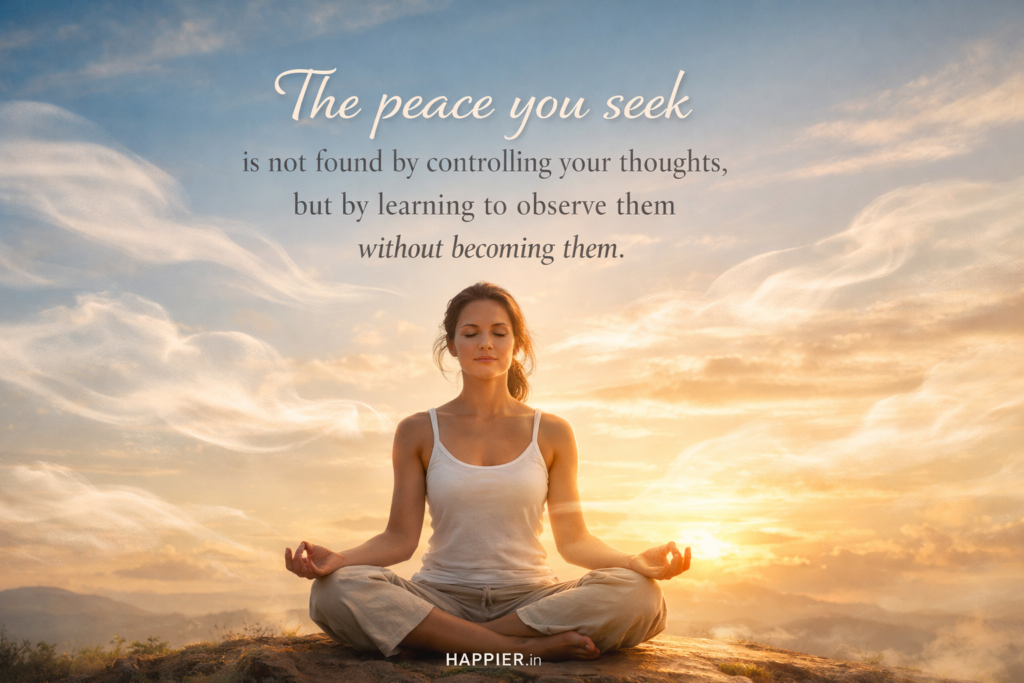
"The peace you seek is not found by controlling your thoughts, but by learning to observe them without becoming them."
Have you ever noticed that the harder you try to stop thinking about something, the more it dominates your mind?
Try this right now: For the next ten seconds, don't think about a pink elephant.
What happened? The pink elephant probably stampeded through your consciousness the moment I told you not to think about it.
This is the fundamental paradox of the human mind—and it's why millions of people struggle with anxiety, intrusive thoughts, and mental exhaustion despite their best efforts to "think positive" or "clear their mind."
The Truth No One Tells You About Peace
For years, I believed peace meant having a quiet mind. No racing thoughts. No worries. Just... stillness.
I tried everything: positive affirmations, thought replacement, mental discipline. I fought my anxious thoughts like an enemy at the gate. And the more I fought, the louder they became.
Then I discovered something that changed everything.
Peace isn't about controlling your thoughts.
It's about changing your relationship with them.
You Are Not Your Thoughts Right now, you're reading these words. But there's a part of you that's aware you're reading. That awareness—that witness—is the real you.
Your thoughts are like clouds passing through the sky of your consciousness. The sky doesn't try to hold onto the clouds or push them away. It simply allows them to pass. You are the sky, not the clouds.
This isn't just poetic metaphor.
Neuroscience confirms it. The Default Mode Network in your brain generates between 60,000 to 80,000 thoughts per day. Most are repetitive. Many are negative. None of them are "you."
When you identify with every thought that arises, you become a prisoner to the chaos of your mind. But when you learn to observe your thoughts without becoming them, something remarkable happens: they lose their power over you.
The Practice That Changes Everything
Let me share the exact practice that transformed my relationship with my mind—and has helped thousands in the Happier.in community.
It's called "Thought Labeling," and it's deceptively simple.
The next time an anxious or negative thought arises, instead of trying to push it away or argue with it, simply notice it and label it: "This is a worry thought." "This is a judgment." "This is fear talking." "This is my inner critic."
That's it. No fighting. No fixing. Just naming.
When you label a thought, you create space between you (the observer) and the thought (the observed). In that space, you reclaim your power.
Why This Works: The Science of Metacognition
When you observe your thoughts, you're engaging a higher cognitive function called metacognition—literally "thinking about thinking."
Research from UCLA's Mindful Awareness Research Center shows that when you label emotions and thoughts, you reduce activity in the amygdala (your brain's fear center) and increase activity in the prefrontal cortex (your brain's wisdom center).
In plain English: Observation calms you down. Control ramps you up.
The practice isn't about stopping thoughts. It's about stopping the identification with thoughts.
The Dark Side of Thought Control
Here's what most self-help advice won't tell you: Trying to control your thoughts often makes things worse.
Psychologists call this "ironic process theory" or the "white bear problem."
When you suppress a thought, your mind creates a monitoring process to ensure you're not thinking about it—which requires you to... think about it.
It's like having a guard standing at the door of your mind saying, "Don't let that thought in!" But to guard against it, the guard must constantly check if it's trying to enter. Which means the guard is thinking about it. All. Day. Long.
This is why people with anxiety disorders who try to control their anxious thoughts often experience more anxiety, not less.
The way out isn't through control. It's through conscious observation.
Your First 7 Days: A Practical Roadmap
Let me give you a week-by-week practice to embody this wisdom:
Days 1-2: Awareness Without Judgment Simply notice when you're lost in thought. Don't judge yourself for it. Just notice. "Oh, I was lost in thought." That's it. Return to the present moment.
Days 3-4: Label Your Thoughts Start naming the thoughts: "Worry thought. Planning thought. Memory. Fantasy." Notice how labeling creates distance.
Days 5-6: Observe the Space Between Thoughts Pay attention to the gaps between thoughts. Even if they're micro-seconds long, those gaps are your true nature—pure awareness.
Day 7: Gratitude for the Observer End the week by appreciating that part of you that can observe. That witness is always peaceful, always present, always free.
The Three Levels of Thought Observation
As you practice, you'll move through three distinct stages:
Level 1: Noticing After the Fact Initially, you'll realize you were lost in thought only after you've been caught up in it for minutes or hours. That's perfect. Noticing at all is progress.
Level 2: Catching Thoughts in Real-Time With practice, you'll start noticing thoughts as they arise. You'll see them forming and can choose whether to engage with them.
Level 3: Resting in Awareness Eventually, you'll spend more time as the observer than as the thinker. Thoughts will still arise, but they won't pull you away from your center.
Most people never reach Level 3—and that's okay.
Even Level 1 will transform your life.
Common Obstacles (And How to Navigate Them)
"My thoughts are too fast and overwhelming." Perfect. That's not a problem—that's data. The faster your thoughts, the more you need this practice. Start with just 60 seconds of observation per day.
"I keep forgetting to observe." Set a reminder on your phone for three times a day: "Am I the thinker or the observer right now?"
"Sometimes observing makes me feel disconnected." This is temporary. You're not becoming disconnected; you're becoming less identified with mental noise. The initial sensation of space can feel unfamiliar. Stay with it.
"What about positive thoughts? Should I observe those too?" Yes. Even positive thoughts are clouds. If you cling to them, you suffer when they pass. Observe them with appreciation, then let them go.
The Invitation
You've been taught to control, manage, and fix your thoughts your entire life.
That approach has brought you here—still searching for peace.
What if the answer isn't more control, but less? What if peace has been here all along, waiting beneath the noise?
You are not your racing thoughts. You are not your anxiety. You are not your inner critic.
You are the vast, quiet awareness that watches all of it arise and dissolve.
That awareness is always peaceful. It's always been peaceful. It's waiting for you to come home.
Your Action Steps
This Week 1. Set a daily reminder: "Who's watching my thoughts right now?" 2. Label one thought per hour: "This is worry" or "This is planning" 3. Journal for 3 minutes each evening: "Today I noticed..." 4. Join our 7-Day Thought Observer Challenge at Happier.in/observer
A Final Thought (That You Can Observe)
The irony of this entire article is that by the time you finish reading it, your mind will have generated dozens of thoughts about what you just read. "This makes sense." "I should try this."
"I've heard this before." "Will this actually work for me?"
Can you observe those thoughts without becoming them? Right now, in this moment, can you feel the space between you and your thinking?
That space is your birthright. That space is peace.
Welcome Home.
—Gopi Krishan Bali Happiness Catalyst | Founder, Happier.in
JOIN THE CONVERSATION:
Share your experience with thought observation in the comments below. What happened when you labeled your first thought? Let's learn from each other's journey to inner peace.
About The Author




More Stories
The Scar That Set Me Free: Understanding True Healing
Initiating the Happier India Revolution
Time to Celebrate World Smile Day :)